Summary
When families compare retirement homes in India, senior living communities, or elderly care homes, they often focus on the property itself: the rooms, food, activities, staff and monthly cost.
But one of the most important factors may be outside the property gates:
How quickly can an older resident reach appropriate medical care when they need it?
For older adults, healthcare needs can be more frequent and more complex because many live with chronic conditions and may require regular consultations, tests, specialist appointments or urgent hospital treatment. Research using nationally representative data from India has found that distance can act as a significant barrier to healthcare access for older adults.
That does not mean every retirement home must be located next door to a hospital.
The more important question is:
Is appropriate medical care realistically accessible from this senior living community when your parent needs it?
A residence located 5 kilometres from a hospital may still face difficult traffic conditions. Another located farther away may have excellent ambulance access, clear emergency protocols and reliable transportation.
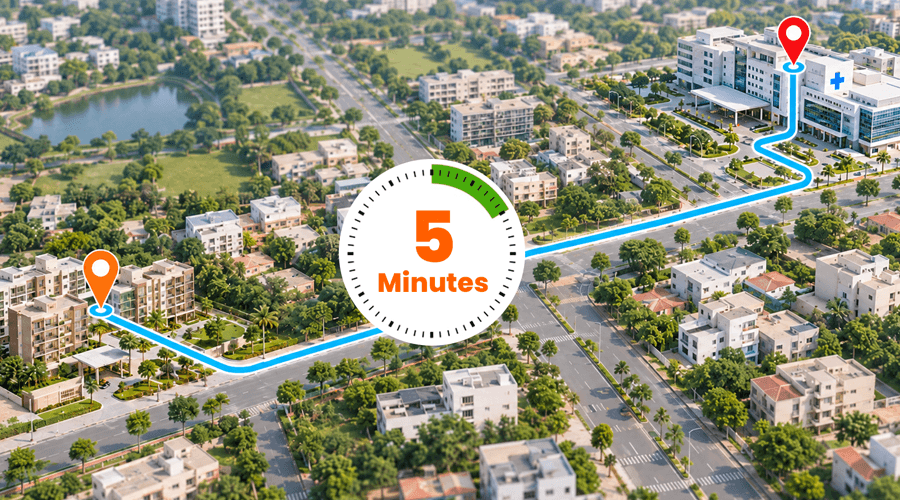
This is why families should evaluate travel time, hospital capability, emergency transport and the residence’s response system – not distance alone.
At Senior Care Joy, we believe choosing a senior care residence means evaluating the entire ecosystem around it, including the healthcare access that can support an older adult beyond everyday life inside the community.
Why Does Hospital Access Matter More for Older Adults?
Ageing does not automatically mean poor health. Many older adults remain active and independent for years.
However, healthcare needs often become more frequent with age.
An older resident may need access to:
- Regular doctor consultations
- Specialist appointments
- Diagnostic tests
- Physiotherapy and rehabilitation
- Emergency treatment
- Hospital admission
- Follow-up care after discharge
Research examining healthcare access among older adults in India has highlighted substantial geographical differences in the distance and time required to reach healthcare facilities. The research also identifies distance as an important barrier to timely healthcare access.
This changes how families should think about location.
When choosing a regular residential property, families may prioritise:
- Views
- Neighbourhood prestige
- Nearby shopping
- Property amenities
When choosing a senior living community, another question becomes equally important:
What happens when healthcare is needed?
Is the Nearest Hospital Always the Best Hospital?
No.
This is one of the biggest mistakes families can make when evaluating a retirement home.
A hospital being physically close does not automatically mean it is suitable for every medical situation.
For example, an older adult may need:
- Emergency medicine
- Cardiology
- Neurology
- Orthopaedic care
- Intensive care
- Surgery
- Geriatric expertise
The nearest facility may provide basic services but may not have the specialist capabilities required for a serious condition.
Instead of asking only:
“How far is the nearest hospital?”
Ask:
“Which hospitals can realistically provide the type of care my parent may need?”
What Should Families Check About Nearby Hospitals?
When visiting retirement homes in India or senior living communities, create a list of nearby healthcare facilities.
Then evaluate them based on more than distance.
| Question | Why It Matters |
|---|---|
| How long does it take to reach the hospital? | Travel time matters more than kilometres alone |
| Does it have emergency services? | Important for urgent medical situations |
| Is it available 24/7? | Emergencies do not follow office hours |
| Does it have relevant specialists? | Older adults may require specialised treatment |
| Does it provide inpatient care? | Some conditions require admission |
| Is it familiar with the resident’s medical history? | Continuity can simplify care |
| Can the residence coordinate transport? | Important when family members are unavailable |
WHO age-friendly housing guidance specifically recognises proximity to health and social services as an important part of creating environments where older people can live safely and comfortably.
Why Is Travel Time More Important Than Distance?
Imagine two senior living communities.
Community A
- Hospital: 6 km away
- Heavy city traffic
- Congested roads
- Travel time: potentially 35–45 minutes
Community B
- Hospital: 12 km away
- Direct highway access
- Reliable ambulance route
- Travel time: potentially 20 minutes
On a map, Community A looks closer.
In reality, Community B may offer faster access.
This is why families should avoid making decisions based only on:
“The hospital is X kilometres away.”
Instead, investigate:
- Normal travel time
- Peak-hour travel time
- Night-time access
- Ambulance routes
- Road conditions
- Seasonal disruptions
A route that works well at 11 AM may be very different at 6 PM.
What Do Studies Tell Us About Healthcare Distance for Older Adults in India?
Healthcare distance is not simply an inconvenience.
Research based on India’s Longitudinal Ageing Study in India (LASI) data found substantial travel burdens for older adults seeking healthcare.
One 2025 analysis involving nationally representative data reported that older adults travelled, on average, approximately 14.5 km for outpatient services and 43.6 km for inpatient care. Healthcare use was higher when facilities were within closer reach, while increasing distance was associated with lower utilisation.
Another recent analysis of LASI data found significant differences across Indian states in the distance and time older adults needed to travel to access outpatient and inpatient healthcare.
The takeaway for families is straightforward:
Healthcare accessibility should be part of the location decision when choosing an elderly care home or senior living community.
What Happens During a Medical Emergency?
This is where the conversation should become very practical.
When visiting a residence, don’t ask only:
“Do you have emergency support?”
Ask the team to describe exactly what happens.
useful emergency sequence should answer:
- Who notices the emergency?
- Who responds first?
- Is trained care staff available?
- Is medical assistance contacted?
- Who calls the ambulance?
- Which hospital is used?
- Who informs the family?
- Does someone accompany the resident?
A vague answer such as:
“Don’t worry, we take care of everything.”
is not as useful as a clear, step-by-step protocol.
Is an Ambulance Arrangement More Important Than Hospital Distance?
In many situations, both matter.
A nearby hospital is valuable, but families should also know whether the residence has a reliable process for getting the resident there.
Ask:
- Does the residence have an ambulance arrangement?
- Is the ambulance operated by the residence or an external provider?
- Who contacts emergency transport?
- Is there a preferred hospital?
- What happens if the preferred hospital is unavailable?
- Does a staff member accompany the resident?
- How quickly is the family informed?
Research on older adults in India has also highlighted transportation barriers as an important part of healthcare accessibility.
The practical lesson is:
A good location is not enough without a good emergency response process.
What About Regular Doctor Visits?
Hospital access is not only about emergencies.
Many older adults need ongoing healthcare for conditions such as:
- Diabetes
- Hypertension
- Arthritis
- Heart conditions
- Neurological conditions
- Mobility problems
Families should therefore investigate how residents manage routine medical appointments.
Ask the residence:
Does the community provide:
- Doctor consultations?
- Visiting doctors?
- Teleconsultation support?
- Transportation to appointments?
- Nursing coordination?
- Medication management?
The ideal healthcare arrangement depends on the resident.
An active and independent older adult may only need convenient transport.
Someone with multiple health conditions may need much more structured support.
How Important Is Access to Specialists?
For many families, the nearest general hospital is only part of the picture.
Consider your parent’s existing health needs.
If they regularly see a:
- Cardiologist
- Neurologist
- Orthopaedic specialist
- Oncologist
- Nephrologist
- Psychiatrist
Ask:
How practical will it be to continue these appointments after moving?
A senior living community may offer an excellent lifestyle, but moving a parent far away from their established medical network can create new challenges.
Should Families Choose a Residence Near Their Parent’s Existing Doctors?
Sometimes, yes.
If your parent has:
- Multiple chronic conditions
- A long-standing specialist relationship
- Regular treatment requirements
- Complex medical history
continuity of care can be an important consideration.
However, this does not necessarily mean the residence must be in the same neighbourhood.
The key question is:
Can your parent realistically continue accessing their existing healthcare providers without excessive travel?
How Does Location Affect Post-Hospital Recovery?
Hospitalisation is not always the end of a health event.
After discharge, an older adult may need:
- Physiotherapy
- Nursing
- Wound care
- Medication monitoring
- Follow-up appointments
- Temporary assistance with daily activities
This creates another important question:
Can the senior living community support recovery after hospital discharge?
Families should ask whether the residence can accommodate temporary increases in care needs – or whether the resident would need to move elsewhere.
What Should NRI Families Consider About Hospital Distance?
For families living abroad, hospital access becomes even more important.
When a son or daughter lives in another country, they cannot always reach the residence immediately.
That means the local emergency system must work without family members physically present.
NRI families should ask:
Communication
- Who contacts the family?
- How quickly are they informed?
- Who is the primary contact?
Medical decisions
- What information does the residence need in advance?
- How are emergency contacts documented?
- How are medical records maintained?
Hospital coordination
- Who accompanies the resident?
- How is admission managed?
- How are updates communicated?
For an NRI family, a residence’s healthcare coordination process can sometimes matter as much as its physical distance from a hospital.
Should a Senior Living Community Have Its Own Medical Facility?
Not necessarily.
Different senior living communities operate under different models.
Some may have:
- On-site nurses
- Regular doctor visits
- Health monitoring
- Basic medical facilities
Others may focus primarily on independent community living and rely on nearby healthcare providers.
Neither model is automatically better.
The important question is whether the model matches the resident’s needs.
An independent senior may prioritise:
- Convenient hospital access
- Transportation
- Emergency coordination
A resident with higher care needs may require:
- More on-site clinical support
- Nursing
- Medication management
- Closer medical supervision
How Can Families Test Hospital Accessibility Before Choosing a Residence?
Don’t rely entirely on what a brochure says.
Do your own location check.
Step 1: Identify the residence
Record the exact address.
Step 2: Identify three nearby hospitals
Don’t evaluate only one.
Include:
- The nearest emergency hospital
- A larger multispecialty hospital
- Any hospital relevant to your parent’s existing condition
Step 3: Check different travel times
Look at:
- Morning
- Evening
- Weekend
- Late night
Step 4: Ask the residence about emergencies
Compare their answer with your own research.
Step 5: Test the route
If possible, physically travel between the residence and the hospital.
This simple exercise can reveal far more than a distance number on a listing page.
The Hospital Access Checklist for Families
Before choosing a retirement home, senior living community or elderly care home, ask:
Hospital Location
- What is the nearest emergency hospital?
- How long does it usually take to reach it?
- How does traffic affect the journey?
- Is there an alternative hospital nearby?
Medical Capability
- Does the hospital have emergency services?
- Does it provide inpatient treatment?
- Are relevant specialists accessible?
- Can your parent continue seeing existing doctors?
Emergency Transport
- What ambulance arrangement does the residence have?
- Who calls the ambulance?
- Who accompanies the resident?
- What happens if family members are unavailable?
Ongoing Healthcare
- Are doctor visits available?
- Is transportation available for appointments?
- Is medication support available?
- Can the residence support post-hospital recovery?
What Are the Red Flags Families Should Watch For?
🚩 “The hospital is nearby” but nobody can explain the emergency process
Distance is not a substitute for a response plan.
🚩 No clarity about night-time emergencies
Ask specifically what happens after regular working hours.
🚩 No transportation plan
A residence should be able to clearly explain how residents access urgent medical care.
🚩 Families must arrange everything themselves
This may be manageable for an independent resident but can be problematic for someone with
significant health needs.
🚩 The residence is isolated
A peaceful location can be attractive – but families should evaluate whether isolation makes
healthcare access difficult.
🚩 No plan for post-hospital care
A hospital stay can temporarily increase an older adult’s care needs.
Is a Peaceful Location Worth Being Farther From Healthcare?
Sometimes – but it depends on the person.
Many premium senior living communities are intentionally located away from congested city centres to provide:
- More open space
- Lower density
- Quieter surroundings
- Better air quality
- Larger campuses
These can offer meaningful lifestyle benefits.
But a peaceful location should be balanced against healthcare access.
The best choice is not automatically:
Closest to a hospital
or
Farthest from the city
Instead, families should look for the right balance between:
Quality of life + healthcare accessibility + reliable emergency response
How Should Hospital Access Affect Your Final Decision?
Hospital distance should be treated as one part of a larger decision.
At Senior Care Joy, we recommend families compare senior care residences across five connected areas:
| Factor | What to Evaluate |
|---|---|
| Daily Living | Comfort, food, activities and independence |
| Safety | Accessibility, fall prevention and emergency systems |
| Healthcare Access | Hospitals, doctors and specialists |
| Response System | Staff availability and emergency coordination |
| Location | Family access, community and transportation |
A residence may have excellent rooms and amenities.
But if healthcare becomes difficult to access when it is needed, the overall location may not be right for that particular resident.
Closing Summary
When choosing between retirement homes in India, senior living communities or elderly care homes, families should look beyond the property itself.
Hospital distance matters because older adults may need more frequent access to healthcare, and research from India shows that geographical distance can become a meaningful barrier to healthcare utilisation.
However, the answer is not simply choosing the residence closest to a hospital.
Families should evaluate:
- Actual travel time
- Traffic conditions
- Hospital capability
- Specialist access
- Emergency transportation
- The residence’s response protocol
- Post-hospital support
The best senior living location is one where an older adult can enjoy everyday life with confidence – while knowing that appropriate healthcare is realistically accessible when needed.
At Senior Care Joy, we believe informed families make better long-term decisions. When comparing senior care residences and communities, don’t just ask what is inside the property.
Ask what support exists beyond its gates.
Key Takeaways
- Hospital distance is an important consideration when choosing senior living.
- Travel time is often more useful than distance in kilometres.
- The nearest hospital may not always provide the care your parent needs.
- Families should evaluate emergency services, specialist availability and transport arrangements.
- A clear emergency response protocol is just as important as location.
- NRI families should pay particular attention to communication and hospital coordination.
- Peaceful locations can be valuable, but isolation should be balanced against healthcare accessibility.
- Always test healthcare access yourself before making a final decision.